
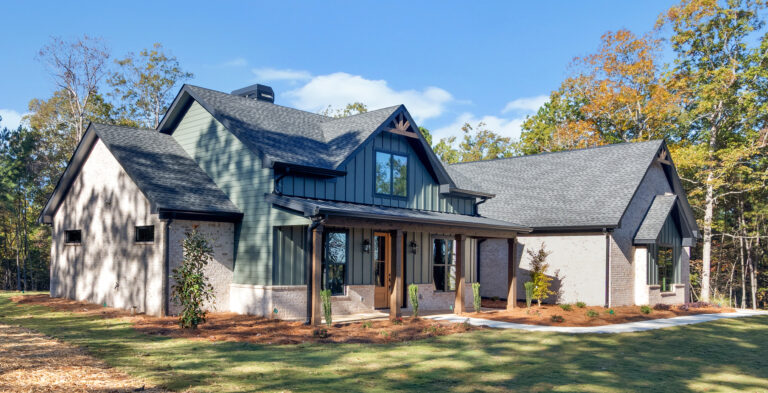
We work with homeowners across Central Georgia who love their land but have outgrown their house, and in some cases, the house itself is past the point where renovation makes financial sense. Our knock down rebuild service exists for exactly this situation. A knock-down rebuild (KDR) means demolishing the existing home and building a brand-new custom home on the same lot.
In Georgia, a KDR typically costs $200,000 to $800,000+ depending on the size and finish level of the new build, and takes 12 to 18 months from demolition to move-in.
We have completed knock down rebuilds across Monroe, Jasper, and Putnam counties, and this guide covers everything we have learned about when it makes sense, what it costs, and how the process works in our region.
When Does a Knock Down Rebuild Make Sense?
- Structural issues are extensive: Foundation failure, widespread termite damage, major water damage, outdated systems requiring full replacement.
- The lot is worth more than the home: Property value driven by location, existing home doesn’t match neighborhood standard, zoning allows larger structure.
- Renovation costs exceed 60% of new build cost.
- Your layout needs are fundamentally different.
When Should You Renovate vs. Knock Down and Rebuild?
| Factor | Favors KDR | Favors Renovation |
|---|---|---|
| Structural condition | Foundation/framing compromised | Structure sound |
| Budget | Renovation cost exceeds 60% of new build | Renovation achieves goals for under 40% |
| Layout | Need fundamentally different floor plan | Existing layout works with minor modifications |
| Energy efficiency | Want modern building envelope | Can retrofit affordably |
| Timeline sensitivity | Can wait 12-18 months | Need to move in under 6 months |
| Lot value | High-value location, home is weak link | Home has character worth preserving |
| Future plans | Staying 15+ years | Selling within 5-7 years |
We focus on custom homes and knock down rebuilds, helping you compare a clean-slate build against the constraints of renovating the existing structure.
What Does a KDR Cost in Georgia?
Demolition Costs
| Home Size | Demolition Cost | Notes |
|---|---|---|
| Under 1,500 sqft | $12,000-$20,000 | Single story, no asbestos |
| 1,500-2,500 sqft | $18,000-$35,000 | May include hazmat assessment |
| 2,500-4,000 sqft | $30,000-$55,000 | Multi-story, complex materials |
| 4,000+ sqft | $45,000-$80,000+ | Large footprint, potential asbestos |
Additional: Asbestos abatement $5,000-$25,000, Septic decommissioning $2,000-$5,000, Tree protection $1,500-$4,000, Utility disconnection $2,000-$6,000.
New Build Costs
The new construction follows custom home pricing:
| Finish Level | Cost per sqft | 2,500 sqft Home |
|---|---|---|
| Entry Custom | $185-$225 | $462,500-$562,500 |
| Mid-Range Custom | $225-$325 | $562,500-$812,500 |
| High-End Custom | $325-$450 | $812,500-$1,125,000 |
Temporary Housing
Budget $20,000-$55,000 for 12-18 months.
Total KDR Budget (Example: 2,000 sqft demo → 2,800 sqft mid-range new build, Monroe County)
| Component | Cost |
|---|---|
| Demolition | $22,000-$35,000 |
| Site prep | $15,000-$30,000 |
| New construction (2,800 sqft @ $275/sqft) | $770,000 |
| Landscaping | $20,000-$45,000 |
| Temporary housing (14 months) | $25,000-$45,000 |
| Permits and fees | $3,000-$6,000 |
| Contingency (8%) | $60,000-$75,000 |
| Total | $915,000-$1,006,000 |
What Does the KDR Process Look Like Step by Step?
Step 1: Feasibility Assessment (2-4 weeks)
We visit your property, assess the existing structure, review your lot’s current zoning and setbacks, and determine whether a KDR is the right path. This includes a structural evaluation to confirm the existing home cannot be cost-effectively renovated, a survey of lot boundaries and easements, soil testing if no recent report exists, and a preliminary code review with your county’s building department. We also run initial numbers so you know whether the project fits your budget before committing to design. If the numbers don’t work, we’ll tell you straight.
Step 2: Design and Engineering (6-12 weeks)
Once feasibility is confirmed, we move into design. This means working with you on floor plans, elevations, and specifications for the new home, all designed to maximize your existing lot. We coordinate with engineers on structural plans, energy modeling, and any site-specific requirements like retaining walls or stormwater management. The deliverable at the end of this phase is a complete set of construction documents ready for permit submission, plus a fixed-price contract so there are no surprises.
Step 3: Permitting (4-8 weeks)
Georgia requires separate demolition and construction permits. We handle both applications, including the demolition plan, asbestos survey (required for homes built before 1980), new construction plans, septic permit if applicable, and any HOA or architectural review board submissions. Timeline varies by county: Monroe County typically processes in 3-4 weeks, Jasper and Putnam can take 5-8 weeks during busy periods. We track every submission and follow up weekly so nothing stalls.
Step 4: Demolition (1-2 weeks)
Before demolition begins, we disconnect all utilities, remove any hazardous materials (asbestos, lead paint), and protect trees, driveways, or outbuildings you want to keep. The actual demolition of a typical 1,500-2,500 sqft home takes 3-5 days. After the structure is down, we remove the foundation, grade the site, and prepare it for new construction. All demolition debris is sorted for recycling where possible and disposed of at licensed facilities.
Step 5: New Construction (10-14 months)
This follows our standard custom home build process. Foundation and framing (8-12 weeks), then mechanical rough-in (plumbing, electrical, HVAC) for 4-6 weeks, followed by inspections, insulation, drywall, and interior finishes. You get a dedicated project manager, weekly photo updates, and access to our client portal for real-time progress tracking. The timeline depends on size and complexity, but most KDR homes in our area complete in 10-14 months from breaking ground.
What Georgia-Specific Factors Affect a KDR?
Permits and Codes
Georgia requires separate demolition and construction permits. The Georgia Department of Community Affairs administers state building codes.
Setback Changes
If current zoning setbacks have changed since the original home was built, your new home may have a smaller buildable area than the existing footprint. This is common in Central Georgia where counties have updated setback requirements over the past 20 years.
| County | Front Setback | Side Setback | Rear Setback | Notes |
|---|---|---|---|---|
| Monroe | 40 ft | 15 ft | 35 ft | Increased rear from 20 ft in 2018 |
| Putnam | 50 ft | 20 ft | 30 ft | Lakefront lots may have additional buffer |
| Jasper | 35 ft | 12 ft | 25 ft | Varies by district |
We run a buildable-area analysis during feasibility to confirm your new design fits within current setbacks. In some cases, a variance application can recover lost square footage, but this adds 6-8 weeks and is not guaranteed.
Septic Considerations
New systems must meet current Georgia DPH standards. Budget $15,000 to $40,000 for a new septic system if needed.
Historic Districts and Covenants
Some communities in our service area have deed restrictions, HOA covenants, or historic preservation overlays that restrict or prohibit demolition. If your property falls within a historic district, you may need a Certificate of Appropriateness before demolition can proceed. HOA architectural review boards typically require submission of new home plans for approval before any work begins, and this process can add 4-12 weeks depending on the association’s meeting schedule.
We check for all recorded restrictions during the feasibility phase. If your lot has covenants that limit demolition or mandate specific architectural styles, we will identify those constraints early so the new home design works within them from day one.
How Do You Finance a Knock Down Rebuild?
| Option | Down Payment | Rate (2026) | Best For |
|---|---|---|---|
| Construction-to-permanent loan | 20-25% | 7.5-8.5% | Most homeowners, converts to mortgage automatically |
| Home equity line + construction loan | Varies | 8-9% (HELOC) + 7.5-8.5% | Homeowners with significant equity in current home |
| Cash for demo + construction loan | Demo cost (~$25K-$50K) | 7.5-8.5% on build | Reduces loan amount, simplifies demo phase |
| Bridge loan | 10-15% | 9-11% | Short-term gap financing while selling another property |
Expect interest-only payments during the construction phase. On a $750,000 build at 8%, that is approximately $5,000 per month in interest payments for 12-14 months. Factor this into your temporary housing budget.
Most lenders require that the new home’s appraised value will exceed total project cost. We provide detailed specifications and comparable sales data to support your loan application.
Is a KDR Right for You? A Decision Checklist
- Your renovation quotes exceed 60% of what a new build would cost
- The existing foundation or framing has structural issues that cannot be economically repaired
- You need a fundamentally different layout that renovation cannot achieve
- You plan to stay in the home for 15+ years (to recoup the investment)
- Your lot value justifies the total project cost
- You can budget for 12-18 months of temporary housing
- You have 20-25% of total project cost available for down payment
If you checked 4 or more, a KDR is likely your best path forward.
FAQs
Is it cheaper to knock down and rebuild or renovate in Georgia?
If renovation costs exceed 60% of a new build, KDR typically wins.
How long does a knock down rebuild take?
12 to 18 months total.
Do I need to move out during a KDR?
Yes.
Can I keep my existing driveway, landscaping, or outbuildings?
Often yes, with proper planning.
Will my property taxes increase after a KDR?
Almost certainly, potentially 50 to 100%+.
Do I need an architect for a KDR?
Not legally required but strongly recommended.
What happens to my existing mortgage during a KDR?
Needs to be paid off or refinanced before demolition.
Ready to Explore Whether a KDR Makes Sense?
Visit our homepage to learn more, explore our full service offerings, or contact us to schedule a consultation.